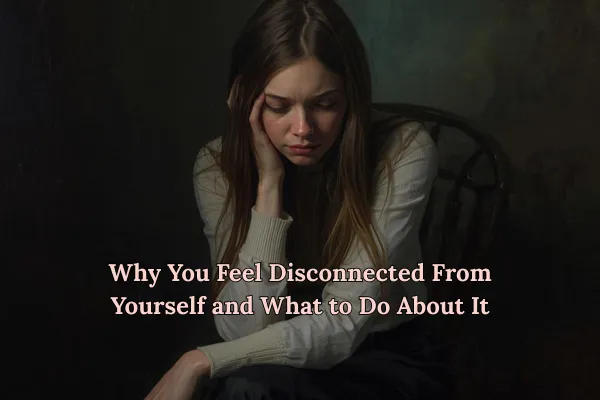
Why You Feel Disconnected From Yourself and What to Do About It
You go through the motions of your life and somewhere inside you there is a quiet question: is this really me? You look in the mirror and feel a strange distance from the person looking back. You show up in your relationships, your work, your daily routines, and you do it well enough. But there is a sense of being slightly removed from your own experience, like you are watching your life from somewhere just behind yourself, rather than living it fully from the inside.
If this resonates, you are not alone. This feeling of disconnection from self is one of the most common experiences women describe when they come to me. And it almost always has roots that go deeper than most people suspect.
What does it mean to feel disconnected from yourself?
Disconnection from self can show up in many ways. Sometimes it is a flatness, an absence of aliveness or passion that you remember having once but cannot seem to access now. Sometimes it is a difficulty knowing what you actually want or feel, as though the channel between your inner experience and your conscious awareness has become unreliable. Sometimes it is a persistent sense of performing yourself rather than being yourself, of presenting a version of who you are without ever quite landing in the truth of it.
None of these experiences mean something is fundamentally wrong with you. They are almost always signs that a protective layer has formed between you and your own inner experience, and that layer formed for a reason. Understanding the reason is the beginning of finding your way back to yourself.
Why disconnection happens
It began as protection
The most common root of disconnection from self is that being fully present in the self was, at some point, not safe. As children, when our emotional experience was consistently denied, minimized, or punished, we learn to distance ourselves from that experience as a survival strategy. We stop trusting our own perceptions. We learn to prioritize what is expected of us over what is actually alive in us. The self goes quiet because quiet is safer.
This is not a failure of character. It is one of the most intelligent adaptations a child can make in a difficult emotional environment. The problem is that the adaptation tends to persist long after the original circumstances have changed.
It can be inherited
Disconnection from self is not always sourced in your own childhood experiences. It can also be inherited. If the women in your lineage were consistently required to suppress their inner experience, their desires, their spiritual sensitivity, or their authentic emotional responses, that suppression can travel forward as a pattern in the family system.
Generations of women who were not allowed to be fully themselves, who had to hide their gifts, their feelings, or their true natures in order to survive socially or physically, can pass forward an unconscious blueprint that says: it is not safe to be fully present in yourself. When you carry this inherited blueprint, the disconnection you feel may be older than your own story.
It deepens when we over-function for others
Many women who carry the mother wound or an inherited pattern of emotional caretaking find that they have spent so long attuned to everyone else's experience that they have gradually lost touch with their own. The antenna is always pointed outward. The inner world receives little attention and begins to feel distant and unfamiliar.
Signs you are disconnected from yourself
You regularly feel numb, flat, or emotionally muted in situations where you expect to feel something. You have difficulty making decisions because you genuinely cannot access what you want. You feel more like an observer of your life than a participant in it. You struggle to know what is authentically you versus what you have absorbed from others' expectations. You feel a persistent sense of missing something or someone, even when you cannot identify what or who.
How to begin coming back to yourself
Start with the body
The body is always in the present moment, even when the mind is not. When you feel disconnected from yourself, slowing down and bringing gentle attention to physical sensation is one of the most direct ways to begin closing the gap. Not analyzing the sensation, simply noticing it. Where is there warmth or tension? What is the quality of your breath? What sensations are present right now that you had not been attending to?
Practice small, honest acts of self-reference
Ask yourself small questions and actually wait for the answer. What do I want to eat right now? Do I want to be in this conversation or would I prefer to be alone? Does this decision feel aligned or does it feel like a performance of what I should want? These small acts of genuine self-inquiry rebuild the connection between inner experience and conscious awareness over time.
Attend to what has been inherited
If the disconnection feels deeper than personal history can account for, it is worth exploring the lineage. Were the women in your family allowed to be fully themselves? Were there patterns of suppression, silencing, or self-abandonment that you may have absorbed? Working at the level of the ancestral pattern can release a quality of disconnection that personal work alone cannot reach.
Frequently asked questions
Is feeling disconnected from yourself a mental health condition?
It can overlap with conditions like dissociation or depersonalization, which are worth discussing with a mental health professional if the experience is severe or disorienting. In many cases, however, it is a spiritual and emotional pattern rather than a clinical condition, and it responds well to the kind of deep inner work described here.
How long does it take to feel reconnected to yourself?
This varies significantly. Some women describe a noticeable shift after even one meaningful session of inner work. For others it is a gradual process of coming home to themselves over weeks and months. The key is consistency and genuine engagement with what is actually present, rather than what you think should be present.
You are allowed to come home to yourself
The self that feels distant has not gone anywhere. It has simply been waiting, patiently, for enough safety and attention to come forward. Every act of genuine self-reference, every moment of honest inner inquiry, every piece of inherited disconnection that you release, brings you closer to the experience of actually inhabiting your own life.
If you sense that ancestral or generational patterns are contributing to how disconnected you feel, a Generational Healing Session can help you find and release what has been keeping you at a distance from yourself. You deserve to feel at home in your own experience.
