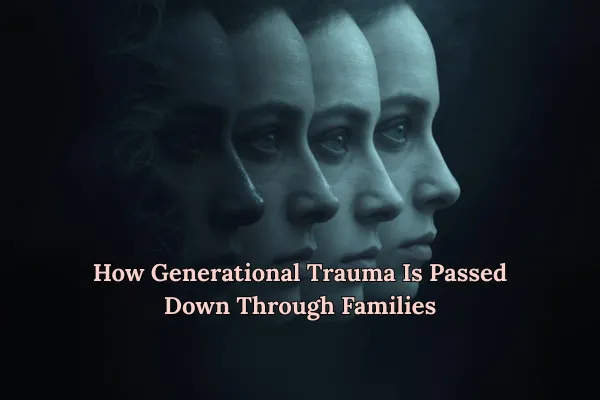
How Generational Trauma Is Passed Down Through Families
Most of us grow up assuming that who we are is shaped by what we have personally experienced. Our childhoods, our relationships, the losses and victories we have lived through. But for many women, there is a persistent sense that something in their emotional life reaches further back than their own memories, something older, something inherited.
That intuition is not wrong.
Generational trauma is real, and it is more common than most people realize. Understanding how it travels through families is one of the most powerful things you can do for your own healing and for the generations that come after you.
What is generational trauma?
Generational trauma, also called intergenerational or inherited trauma, refers to the psychological and emotional wounds that are passed from one generation to the next. These are not just stories or memories. They are patterns, fears, survival strategies, and beliefs that become embedded in the family system and continue to shape behavior long after the original event has passed.
The families that carry this are not damaged or unusual. Every family has experienced hardship at some point in its history. What determines whether trauma becomes generational is less about what happened and more about whether it was processed, spoken about, and metabolized. When it was not, it gets passed forward.
How trauma gets passed down through families
Biology and epigenetics
One of the most striking recent developments in trauma research involves epigenetics, the study of how experiences can influence gene expression without changing the genetic code itself. Research on survivors of significant collective trauma and their descendants has found measurable biological differences in how stress hormones are regulated, suggesting that the body itself can carry the imprint of a previous generation's fear or pain.
This does not mean you are destined to repeat your ancestors' suffering. Epigenetic changes can be influenced by healing and changed circumstances. But it does mean that the body has its own memory, and that memory runs deeper than conscious thought.
Emotional conditioning in childhood
Children are extraordinarily sensitive to the emotional environment they are raised in. Long before they have words for what they are sensing, they are absorbing the emotional patterns of their caregivers. If a parent carries unprocessed fear, the child learns that the world is fundamentally unsafe. If a parent carries unspoken grief, the child may absorb a nameless sadness without ever understanding its source.
This is not about parents doing anything wrong. It is simply the nature of how humans learn. We are wired to attune to the people closest to us, and that attunement extends to their emotional and nervous system states.
Unspoken and suppressed experiences of trauma
Family secrets and unspoken events are one of the most potent vehicles for generational trauma transmission. When something painful cannot be named or spoken, it does not disappear. It goes underground, living in the emotional atmosphere of the family and showing up in the behavior, the anxiety, the relationship patterns of the next generation.
Children often sense these silences even when they cannot articulate them. They feel the weight of what is not being said. And in the absence of information, they tend to fill the gap with self-blame or a vague sense that something is wrong with them, rather than understanding that they are simply feeling the memories of something that came before.
Inherited beliefs about the self and the world
Every family system carries a set of beliefs that operate almost like an invisible rulebook. Beliefs about whether the world is safe or threatening. Whether love is reliable or conditional. Whether you are worthy of abundance or meant to struggle. Whether emotions are something to be expressed or suppressed. These beliefs are rarely stated outright. They are transmitted through behavior, through tone, through what gets praised and what gets punished.
By the time we reach adulthood, many of these beliefs feel simply like facts about reality. Examining them and asking where they came from is one of the most clarifying things you can do.
Common Generational Trauma Patterns
Generational trauma tends to cluster around a few core themes. You may recognize yourself in one or several of these.
Around relationships: patterns of emotional unavailability, fear of abandonment, difficulty trusting, choosing partners who replicate early experiences of being unseen or unvalued.
Around money and safety: chronic scarcity thinking, difficulty receiving abundance, financial self-sabotage, or persistent anxiety about survival even when circumstances are stable.
Around self-worth: a deep belief that you are fundamentally not enough, that your needs are burdensome, or that you must earn love through achieving or caretaking.
Around the body: disconnection from physical sensations, chronic tension, illness patterns that mirror those of previous generations, or difficulty feeling safe in your own body.
Why Healing One Person Can Shift the Family Lineage
This is something I have witnessed again and again in my work with women. When one person in a family does the deep work of ancestral and generational healing, the effects ripple outward in ways that are both practical and mysterious.
Practically, a healed parent raises children differently. They respond rather than react. They can offer what they themselves are now receiving: safety, attunement, presence. The transmission of fear and unprocessed pain slows because the channel has been cleared.
Spiritually, there is something even larger at work. When you heal a wound in yourself that belongs to your lineage, you are not just changing your own story. You are doing something on behalf of the generations that could not do it for themselves, and opening something new for those who come after you.
Frequently Asked Questions About Ancestral Healing
Can generational trauma affect me even if my parents seemed fine?
Yes. Generational trauma can skip or appear subdued in certain generations before surfacing again. Parents who appear functional may still carry unprocessed pain that shapes the emotional environment of the home in subtle ways.
Do I need my family's participation to heal generational trauma?
No. The healing you do within yourself does not require anyone else's involvement or agreement. You are working with what lives in you, and that is entirely within your own reach.
Is generational trauma healing the same as family therapy?
They are different approaches. Family therapy works with living relationships and communication patterns. Generational healing works at the level of the lineage, addressing what was passed down through deeper emotional and spiritual channels rather than only what is visible in current family dynamics.
Heal Your Inherited Family Emotional Trauma
Understanding how generational trauma travels is the first step toward interrupting it. The next step is doing the deeper work of actually releasing what you have inherited.
If you feel the weight of patterns that belong to more than just your own story, a Generational Healing Session offers a compassionate and grounded space to begin. We will explore the emotional and spiritual layers of your lineage together and start the process of clearing what no longer needs to be carried forward so you can feel lighter, happier, and more like your true nature. Ancestral healing just may be the gateway of liberation that you've been seeking to live a life of freedom.
Looking for your next certification as a healer, life coach, therapist, or yoga teacher? Sign up for the next 7-Day in-person Generational Healing® Certification in the US, UK, and Australia with Sarah Christine Gill at Intuitive Soul Blossom.
