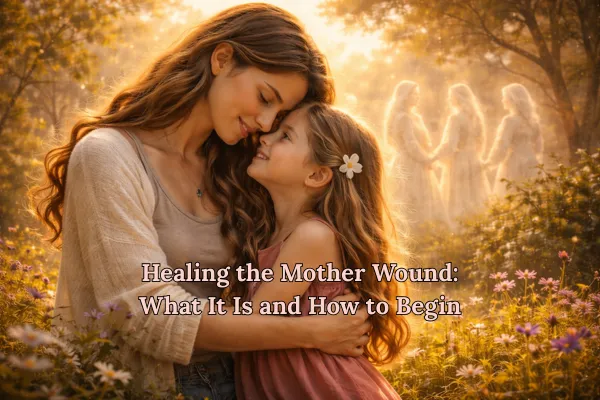
Healing the Mother Wound: What It Is and How to Begin
Of all the wounds that women carry, the mother wound is one of the most tender and one of the most common. It lives close to the center of who we believe ourselves to be, shaping the way we receive love, the way we speak to ourselves, the way we inhabit our own bodies, and the way we mother the children who come after us.
And yet it is rarely talked about with the clarity and compassion it deserves.
This post is for the woman who has always sensed that something important and unresolved lives in the space between her and her mother. For the woman who loves her mother and also carries real pain from their relationship. For the woman who has tried to understand her mother's limitations and still cannot quite shake the ache of what was missing.
What is the mother wound?
The mother wound refers to the pain, unmet needs, and inherited patterns that arise from the relationship with our mother or primary maternal caregiver. It is not about blame. Most mothers are doing the best they can with what they themselves received. But when a mother has unresolved wounds of her own, those wounds shape the emotional environment in which her children are raised, often in ways that leave lasting impressions.
The mother wound can show up as a felt sense of not being enough, a difficulty receiving love without conditions, a pattern of over-giving or self-abandonment, a chronic inner critic whose voice sounds remarkably like early criticism absorbed in childhood, or a deep ache for a kind of nurturing that was never quite available.
It is also, importantly, an inherited wound. The pain your mother carried was often passed to her from her own mother, and from the women who came before in the lineage. This is why healing the mother wound spiritually, at the level of the lineage rather than only the personal relationship, can be so much more freeing than addressing it purely through the lens of individual psychology.
How the mother wound shows up in your life
In your relationship with yourself
The quality of our earliest attachment shapes the quality of our inner relationship. When the mother wound is present, women often describe an inner voice that is harsh, minimizing, or never quite satisfied. A persistent sense of being too much or not enough. A difficulty in trusting their own perceptions, because early experiences of having their reality denied or dismissed taught them not to.
In your relationships with others
Attachment patterns formed in the earliest relationship with the mother tend to replay in adult intimate relationships. A fear of abandonment. A tendency to over-function emotionally while under-receiving. Difficulty asking for what you need, because early experience taught you that needs were burdensome or unsafe. A pattern of choosing partners who replicate the emotional unavailability of the early mother relationship.
In your relationship with your own body
The mother wound often lives in the body. Tension in the chest or throat. A habitual bracing or contraction. Difficulty feeling at home in yourself. The body remembers what the mind has tried to process, and it tends to hold unresolved mother material in particular ways that are worth bringing attention to.
In your relationship with your own children
One of the most significant ways the mother wound expresses itself is in our mothering. Not through failure or neglect, but through the subtle ways that our own unhealed patterns surface in relationship with our children. The moments when our child's need triggers our own unmet need. The ways our expectations or fears are shaped by what was modeled to us. The ways we long to give our children something different but find ourselves reaching unconsciously for familiar patterns.
Why addressing it at the level of the lineage matters
Your mother's limitations did not begin with her. She received what she received from her own mother, who received from hers. The wound travels through the maternal line, often intensifying in generations where there was significant collective suffering, displacement, loss, or suppression of the feminine.
When we work with the mother wound only at the level of the personal relationship, we are often left with a cycle of understanding and forgiving that brings some relief but does not fully resolve the inherited layer. When we go into the lineage itself, into the unresolved pain of the women who came before, something different becomes available. We are not just healing our relationship with our individual mother. We are healing a pattern that has been traveling through the women in our family for generations.
This is the work that I find creates the most lasting change. Not because the personal relationship does not matter, but because the root of what is being carried often predates it.
How to begin healing the mother wound
The first step is compassionate recognition. Naming what was missing, what was painful, and what you have been carrying, without minimizing it and without collapsing into blame. This is not about indicting your mother. It is about telling yourself the truth about your own experience with enough tenderness to actually feel it.
The second step is beginning to separate what belongs to you from what was inherited. Which beliefs about yourself came from your own direct experience? Which were absorbed from the emotional environment of your early home? Which feel older even than that, like they have been traveling through the women in your family for longer than one lifetime?
The third step is finding support that can hold the depth of this work. The mother wound is tender territory. It responds well to compassionate guidance, to being witnessed, and to approaches that work at the level of the emotional and energetic body rather than only the analytical mind.
Frequently asked questions
Do I need to have had a difficult relationship with my mother to have the mother wound?
Not necessarily. Even women who had loving, well-intentioned mothers can carry the mother wound if their mother had her own unresolved pain that shaped the emotional environment. And the wound can also be inherited from further back in the lineage, predating the personal mother relationship entirely.
Can healing the mother wound affect my relationship with my own children?
Yes, and this is one of the most profound gifts of this work. As you release what you have been carrying from the maternal line, you naturally parent from a different place. More present. More spacious. Less reactive. What you heal in yourself becomes a different inheritance for your children.
Is this work only for women whose mothers are still living?
No. This work does not require your mother to be living or to participate. It happens within you and within the lineage, not between you and your specific mother in the present. Women often find this work equally powerful regardless of their mother's current circumstances.
You deserve to be free of this
The mother wound asks a lot of the women who carry it. It asks them to perform love without fully receiving it. To mother well while still longing to be mothered. To give from an inner well that was never quite filled.
You do not have to keep doing this. The wound that has traveled through the women in your line is ready to be seen, held, and released. And when it is, something opens that no amount of understanding alone can create.
If you feel called to do this work, a Generational Healing Session is a tender and powerful place to begin. I would be honored to support you in this.
